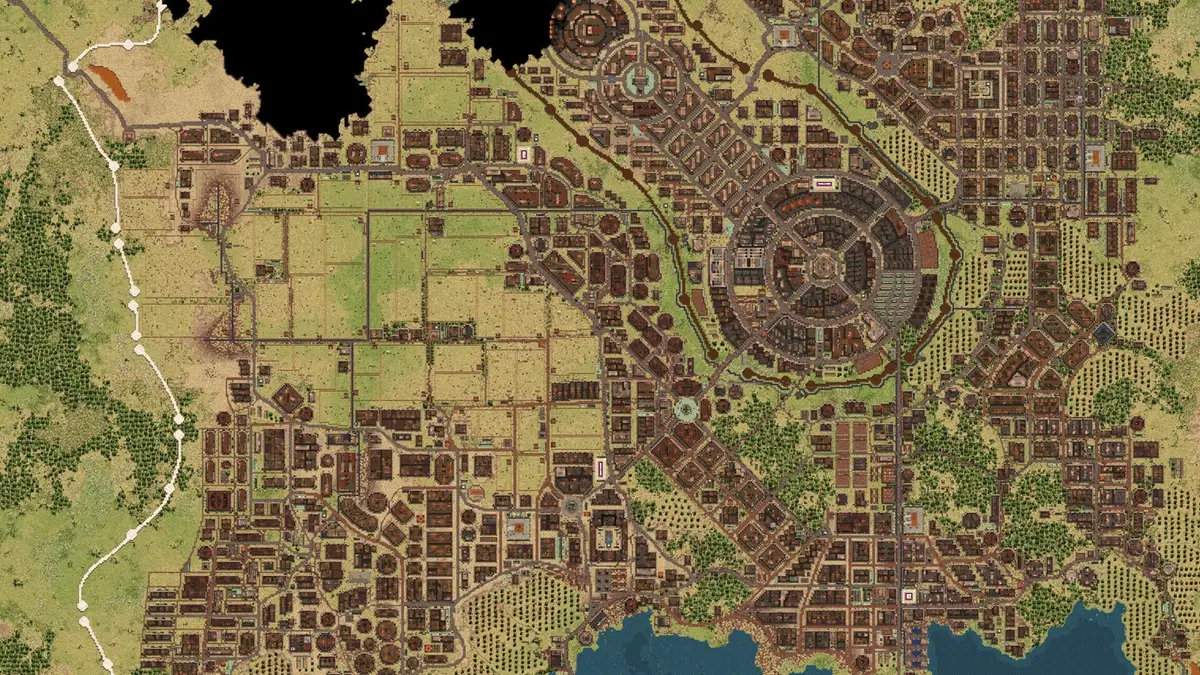
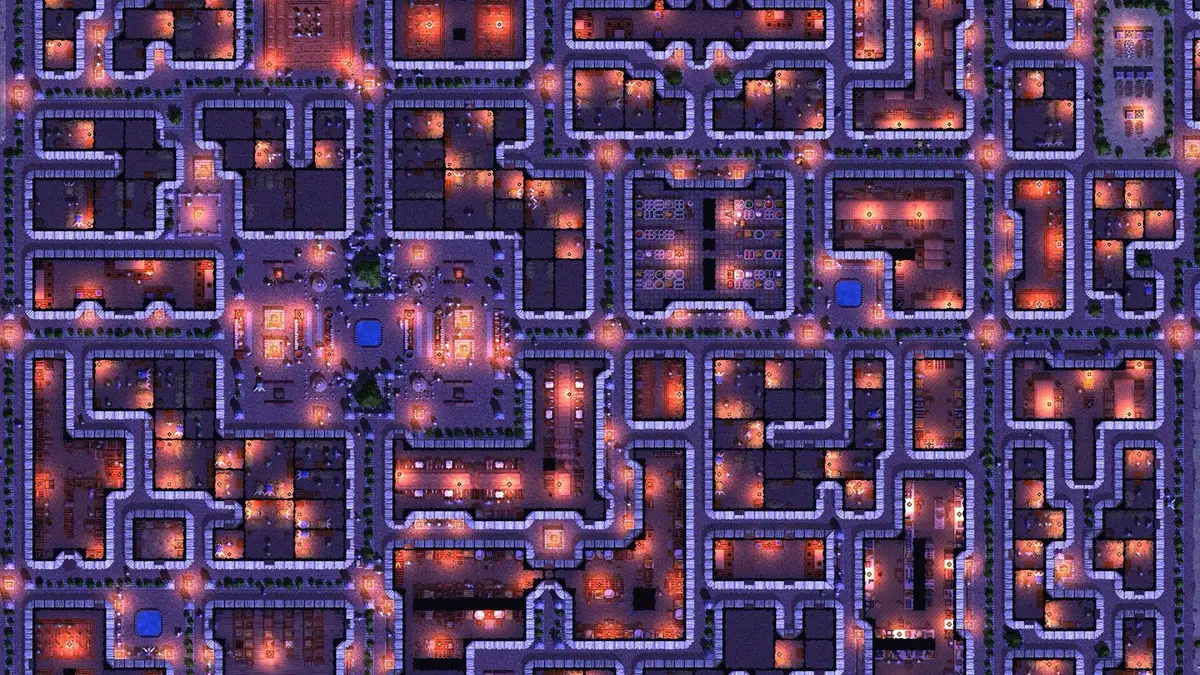
The site you pick on the world map is not a difficulty setting, it is a permissions list. Freshwater decides whether you can irrigate. Mountain tiles decide whether you have ore at all. Climate decides which crops are viable and whether your Health score starts with a tailwind or without one. Everything else in your city can be rebuilt later; the tile cannot.
Values in Songs of Syx move between versions, so treat the relationships below as the durable part and your own Tome of Knowledge as the authority on any specific number.
The site feature matrix
Read this before you click. Each row is something you either have on the tile or do not.
| Site feature | What it unlocks | What suffers without it | Can you work around it? |
|---|---|---|---|
| Freshwater (river or lake) | Water Pumps, which must sit adjacent to freshwater and generate the pressure canals run on | Farms and orchards want 90% moisture for full efficiency; without irrigation you are hostage to natural moisture | Partly — site on naturally wet ground, but you lose the ability to raise moisture on demand |
| Forest cover | Woodcutter zones, and wood is the input to Furniture, Coal via Charcoaler, Paper, Bows, Spears and Shields | Almost every construction and maintenance chain, because mines themselves need Furniture to build and to maintain | Yes, by trade, but you are importing the most-used bulk good in the game forever |
| Mountain tiles in the capital region | Stone, Ore, Gem and Sithilon mines; mineral deposits are “more plentiful” on mountainous world tiles | Metal Smelter, Smithy, Jeweller and every tool or armour chain downstream | Yes, by trade or slave-worked deposits, but metal becomes a permanent import bill |
| Water tiles in the capital region | Clay, which the wiki notes is the exception to the mountain rule and is more common where water tiles are included | Pottery, and through Pottery the Brewery; Laboratories are also boosted with Clay | Yes, clay is cheap to buy, but the Brewery chain stalls whenever a shipment is late |
| Rich soil / Till / Alluvium | Farm output, and Alluvium is the good case for Woodcutters at 25 square area per productivity step | Infertile ground needs 400 square area per Woodcutter productivity step versus 100 on regular soil | Only by building far bigger zones for the same output |
The three climates, side by side
Freshwater, forest and mountains decide what you can build. Climate decides something different: it sets your Health baseline before a single building goes up, and it picks which crops and animals are worth raising on that tile at all.
| Cold | Temperate | Warm | |
|---|---|---|---|
| Health | Boosted | Not boosted | Boosted |
| Species that prefer it | Dondorians | Cretonians, Humans, Tilapi | Garthimi, Amevias |
| Crops boosted | Mushrooms, Herbs | — | Cotton, Opiates |
| Crops penalised | Cotton, Opiates | — | Herbs, Mushrooms |
| Livestock boosted | Warbeasts, Onx | Entelodonts, Aurochs | Globdiens |
| Livestock penalised | Aurochs, Entelodonts, Globdiens | Warbeasts take a minor production penalty | Aurochs, Entelodonts, Warbeasts, Onx |
| Other boosts | Fish, Hunters | — | — |
| Mandatory building | Hearths, which keep every species alive | Both hearths and wells, for less frequent spikes in both directions | Wells, because of frequently extreme temperatures |
| Wildlife note | Wild Stagbeasts present; wild Globdiens and Dinoris absent | — | — |
Cold is the beginner-friendly extreme. It boosts Health, it boosts three separate food sources at once — Mushrooms, Fish and Hunters — and the wiki says plainly that hearths help keep plebs of every species alive there. You are not restricted to Dondorians just because they prefer it. What you give up is the cotton and opiate branch, which means Fabric comes from trade and your Tailor runs on leather instead.
Warm is the specialist extreme. Health boosted, cotton and opiates boosted, but wells stop being an optimisation and become load-bearing: the wiki calls out frequently extreme high temperatures as the reason wells matter more here than anywhere else. Amevias are fairly heat-resistant and will still overheat and die without a way to cool off.
Temperate is the widest species overlap and the thinnest safety margin. Three species prefer it, so your immigration pool is broadest. In exchange the temperature can swing dangerously hot in summer and dangerously cold in winter, so you build both hearths and wells, and you get no Health bonus to offset either.
The temperature mechanic that catches unprepared cities
An unready city can lose a lot of citizens to a heat or cold spike in a single season, and the mechanism behind it is a range problem, not a raw-number one:
- Wells and hearths are range-limited. A well has a service radius of 100 per the wiki’s own stat block, and a citizen out of range when a spike hits simply cannot reach one in time. Somebody working a distant farm or mine can be caught the same way a hearth-poor district can in winter.
- Clothes are the exception. Clothes help a citizen stay warm or cool and provide a benefit in any temperature, regardless of where the citizen is on the city map. That makes clothing the only location-independent defence you have — and clothing is a Tailor output, from Leather or Fabric.
So the ordering is: wells and hearths in the residential core early, and a working Tailor chain before your workforce spreads out across the map. The production chain map shows what the Tailor needs upstream. Wells also scale with level: the wiki lists a Health-bonus multiplier of x1.333 at level 1, rising to x1.417 at level 2 and x1.5 at level 3, so an unupgraded well is leaving a further Health gain on the table, not just serving a smaller radius.
Climate is a food decision more than a comfort decision
Climate does not slightly adjust farm output — it moves entire crops in and out of viability. Mushrooms only grow efficiently in a cold climate. Cotton is strongly boosted in hot and worse in cold. Herbs boost in cold and suffer in hot. Opiates are easier in hot and harder in cold.
That matters because of the food variety mechanic: there is an additional health bonus and fulfilment for food variety when multiple preferred foods are available. A climate that removes a crop from your menu is quietly removing a happiness source too, not just a tonnage figure. Whether your remaining crops actually cover your population is arithmetic — the food balance calculator takes your own field and population numbers, because days of food is a ratio and it falls while your barns fill.
Consumption gives you the demand side of that ratio: citizens consume roughly one food unit every two days, varying by species. Amevias sit around 0.375 units daily; most other species land around 0.4 to 0.5 per day at standard access levels.
Read the matrix in the right order
Freshwater and forest are hard constraints. Mountain and water tiles are bills. Climate sits apart from both — it is neither a lock nor an invoice, it is the baseline your Health score and your crop list start from for the whole run.
Freshwater and forest are constraints. Without a pump site you cannot raise moisture, and moisture is the thing farms, pastures, orchards and Woodcutters all read. Without wood you cannot build or maintain the buildings that would let you buy wood efficiently. The official beginner walkthrough puts both in the same sentence for a reason: it tells a first-time player to place the capital in a temperate area with 100% moisture, forest, and a river.
Mountain and water tiles are bills. A capital with no mountains still works; it just means metal, tools and armour arrive by ship and your treasury has a standing monthly commitment. Whether that commitment is worth it is not a matter of opinion — it is a worker-day comparison, and the import-or-produce calculator does exactly that conversion.
Climate is the one row you cannot fix by trading. You can import wood, ore and clay. You cannot import a Health bonus or a crop that only grows in the other climate. If your species roster leans cold-preferring or warm-preferring, weigh that before the temperate default, because the walkthrough’s “widest overlap” advice is a population-size argument, not a Health argument.
Where to put the throne once you have the tile
The walkthrough’s placement advice is the part most people skip: put the throne near the river but on infertile soil. Riverside rich soil is the scarcest thing on your map and a throne sitting on it is permanently wasted farmland. The same logic applies to your first warehouses and your first housing block. Ugly ground is where buildings go.
Keep two more distances in mind at placement time, because both are cheap now and expensive later:
- Noise. A building’s noise spreads from its zone, drops in intensity every 5 tiles, and stops at 15 tiles. Walls cut it roughly in half and proper insulation blocks at least 66%. Five tiles of gap between industry and housing is the minimum the wiki suggests.
- Species distance. Two species with less than 100% mutual preference can brawl within 58 tiles, measured doorway to doorway. If you intend to mix, you are planning a city with 58-tile districts, not a compact one. Housing distance is also a happiness input, and the need-floor calculator shows how one unmet category caps the rest.
And climate is a happiness decision too
Every species has heat and cold resistance stats matching its preferred climate, so climate is one of the inputs to whether your population is content. But it is only one input, and fulfilment does not average — happiness follows your worst-covered need, not the mean of all of them. If your city is cold, well-fed and still unhappy, climate is not the culprit; the need-floor calculator will name the category that is.
What a bad site does not do
It does not end the run. The capital is the only city that is directly simulated, and the wiki lists no lose condition for it: the run keeps going no matter how far population or stockpiles have fallen, because new immigrants keep arriving and map resources regrow, respawn, or come from deposits that never run out. A bad site makes your city slower and more import-dependent. It does not delete it.
That matters for how you should treat your first two or three attempts. Restarting because the tile was wrong is reasonable. Restarting because the city is currently failing usually is not — the failure is almost always a balance running negative, and the colony audit checklist will find it faster than a new map will.
What site selection has no formula for
The wiki does not publish numeric mineral richness values per world tile, the exact moisture percentage lost per tile of distance from a canal, a formula converting climate to a Health score change, or a temperature threshold at which citizens begin to die. It states the direction of each effect and, where a figure exists, this page quotes it. Where none exists, this page says so rather than estimating one. Canal spread is the one hard distance published: each canal tile can spread up to 15 tiles at maximum moisture value.
Sources
- Songs of Syx Wiki, Climate — the three climates, Health boosted in cold and warm, per-climate crop, livestock and wildlife lists, species preferences
- Songs of Syx Wiki, Temperature — range-limited wells and hearths, clothes as location-independent protection, species resistance stats, summer/winter swings
- Songs of Syx Wiki, Irrigation — pumps adjacent to freshwater, canal spread of up to 15 tiles, culverts and water pressure
- Songs of Syx Wiki, Farming — soil ranking, 90% moisture target, mushrooms cold-only, fibre (the game’s cotton-equivalent crop) hot-boosted, herbs cold-boosted, opiates hot-boosted
- Songs of Syx Wiki, Mines — mine types, mountainous world tiles for minerals, water tiles for clay, Furniture upkeep
- Songs of Syx Wiki, Woodcutter — 25/100/400 square area per productivity step by soil type, stone and furniture build cost
- Songs of Syx Wiki, Well — service radius of 100, per-level Health-bonus multipliers of x1.333, x1.417 and x1.5
- Songs of Syx Wiki, Noise — 5-tile falloff, 15-tile maximum, walls halving noise, 66% insulation figure
- Songs of Syx Wiki, House — the 58-tile, doorway-to-doorway brawl distance between species with less than 100% mutual preference
- Songs of Syx Wiki, Food — consumption of about one unit per two days, Amevia 0.375 daily, 0.4 to 0.5 for most species, the variety bonus
- Songs of Syx Wiki, Capital City — capital as the only directly simulated city, absence of a lose condition
- Songs of Syx Wiki, Beginner’s Guide - Emir — temperate, 100% moisture, forest and river placement advice, throne on infertile soil
- Steam news, V71 - Reign of Terror - Available Now — current version and release date used as the baseline for this page