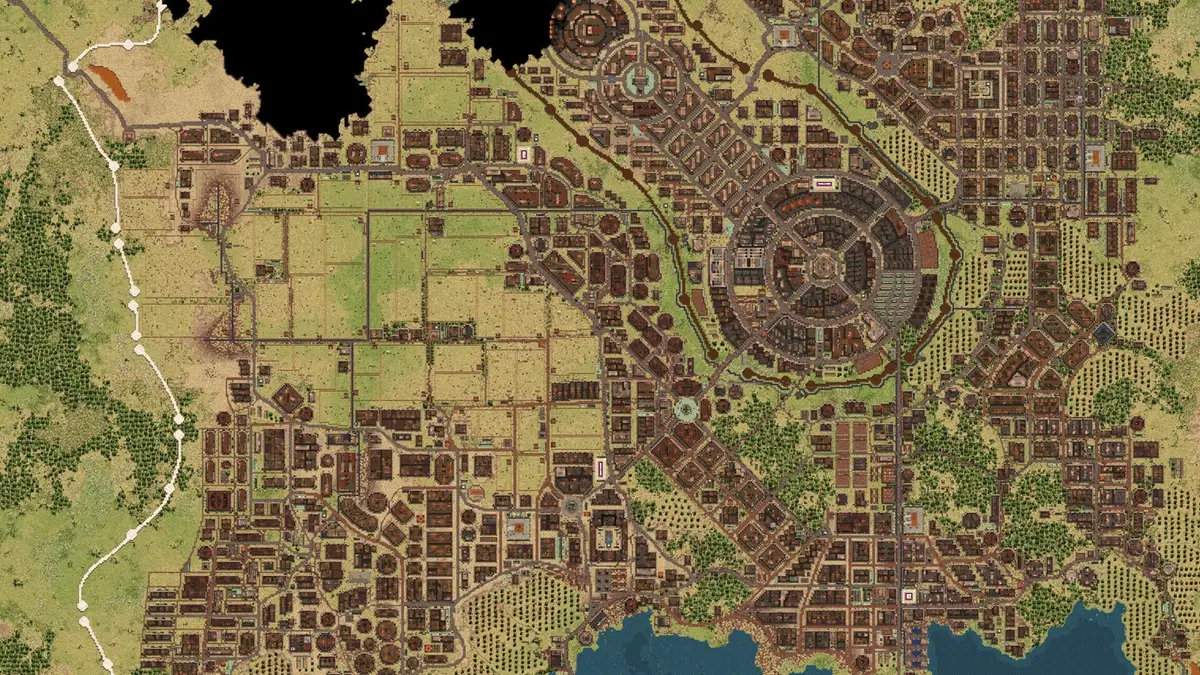
“Is there any reason not to train conscripts to max?” collects replies that mostly assume the question has one answer. It doesn’t. Training every conscript to the cap is the right call against one kind of threat and a slow-motion mistake against another, and the difference is not about how strong you can afford to make your army — it’s about what shape of threat that army actually has to answer.
What “max” is actually buying you
Training to the cap spends two things you cannot spend twice: time, and training-ground throughput. On the time side, each point of Melee Training takes an average of 10 days per soldier at a Training Ground, and that rate only improves through building upgrades (Metal, then Metal + Machinery) or research spent in the Soldering technology — there is no free lunch, only a faster spend. On the throughput side, the Employee and Recruits Limit sliders on a Training Ground are proportionally linked, so a slot spent finishing one soldier’s rank is a slot a fresh conscript cannot use. What you get back for that spend is per-soldier quality, and that quality has both a species floor and a species cost: at the Training Ground every species trains at the same 100% skill rate, but fulfilment while training ranges from -50% (Cretonians) through 50-75% (Dondorians, Garthimi, Humans, Amevias, Tilapi) to a flat 0% for the two combat-specialist haven species, Argonosh and Cantor. Amevias are described as slow to mature but excellent soldiers, and Argonosh and Cantor are built around combat strength specifically — so which species make up your garrison changes both how much a “maxed” soldier is worth and how much morale it costs to get them there. Whether the training spend is worth it depends entirely on whether your problem is a small number of dangerous fights or a large number of low-stakes ones.
Match the garrison to the threat
This is the row-by-row trade-off, and the two threat profiles at the top give genuinely opposite guidance rather than a difference of degree — one says spend the budget concentrating quality, the other says spend the same budget spreading coverage.
| Threat profile | Train to max? | Why | What you give up |
|---|---|---|---|
| Rare, high-stakes fights (raider warbands, late-game invasions) | Yes — concentrate quality in a smaller elite core | A small force that loses to a strong attacker loses everything at once; quality reduces that risk more than headcount does | Coverage — this force can’t be everywhere, and garrisoning every province thin leaves gaps |
| Frequent, low-stakes unrest (rebellion risk across many provinces) | No — spread a larger conscript garrison instead | In our games, rebellion risk tracked garrison presence per province more closely than the quality of any one soldier in it — we have not seen a fixed formula for this from the developer, so treat it as an observation, not a rule; being everywhere beats being elite in one place | Per-soldier strength — this garrison loses individual engagements it could have won maxed out |
| Mixed: several provinces, occasional real threats | Partial — max a mobile reserve, leave provincial garrisons at conscript level | You get the coverage of the second row and the reserve strength of the first, at a smaller scale of each | Neither extreme — this is slower to build than either pure strategy |
| Early game, uncertain threat | No — training capacity is your scarcest resource, not upkeep | You don’t yet know which threat profile you’re actually facing; committing training slots to max-rank soldiers before you know locks in the wrong shape | Readiness for the specific threat that turns out to matter |
The first two rows are the ones worth reading twice: identical starting resources, identical “train to max?” question, opposite correct answer, because a rebellion-risk problem and a warband-raid problem are solved by different properties of the same army. Reading rebellion mechanics as a combat-strength problem — and reaching for max-rank training because it “sounds stronger” — is the specific mistake this table exists to head off.
Why this isn’t just “it depends”
“It depends” is true and useless on its own. What makes the table above more than an opinion is that the two rows at the top point at what plays out as a mechanical split in this game: raid and invasion outcomes come down to unit-for-unit combat strength in one place at one time (a concentration problem), while in our games unrest and rebellion risk tracked garrison presence and loyalty across provinces more closely than any one soldier’s quality (a coverage problem) — we have not seen the developer publish an exact rebellion-risk formula, so read that half as an observation from play rather than a documented rule. Either way, those are different demands on the same training-ground throughput, which is exactly why one training strategy cannot be correct for both.
Sources
- Songs of Syx Wiki, Training Ground — the 10-days-per-melee-training-point rate, the Metal/Machinery/Soldering upgrade paths, the Employee and Recruits Limit sliders being proportionally linked, and the per-species skill/fulfilment table (Cretonians -50% through Argonosh/Cantor 0%)
- Songs of Syx Wiki, Species — per-species combat aptitude (Amevia, Argonosh, Cantor) backing the “quality has a species floor” point
- V71 - Reign of Terror - Available Now (Steam) — the law/order and slavery rework this article’s threat-profile framing sits on top of; the patch notes do not publish a rebellion-risk formula, which is why the garrison-presence claim below is flagged as an observation from play rather than a documented rule